Quick take: An 83(b) election lets you pay taxes on restricted stock at its current value rather than its potentially much higher future value. You have exactly 30 days from your grant date to file. Miss the deadline and there are no extensions, no exceptions. The IRS now accepts electronic filings through their online portal using Form 15620, which is faster and provides instant confirmation. You can also still file by mail.
If you just received a restricted stock grant or exercised stock options early, this is one of the most consequential tax decisions you will make. The difference between filing and not filing can mean tens or hundreds of thousands of dollars in taxes depending on how much your company grows.
This guide walks you through the entire process, from gathering your grant details to getting confirmation that your election was received.
What You Need Before You Start
Before filling out the form, collect the following information about your equity grant:
| Information Needed | Where to Find It |
|---|---|
| Your full legal name, address, and SSN/TIN | Personal records |
| Grant date (date the board approved the grant) | Stock option agreement or cap table platform |
| Number of shares | Stock option agreement |
| Type of shares (common, preferred, ISO, NSO) | Stock option agreement |
| Fair market value (FMV) per share on grant date | Company’s most recent 409A valuation |
| Amount you paid per share | Exercise agreement or grant letter |
| Issuing company’s legal name and EIN | Company records or stock agreement |
The grant date is when the board approved the grant, which can be days or even weeks before you receive the official paperwork. This is the date that starts your 30-day clock, so confirm it immediately.
Step 1: Complete IRS Form 15620
The IRS released Form 15620 as the official standardized form for making an 83(b) election. While some people still use a written letter format provided by their law firm, Form 15620 is now the recommended approach and is required for electronic filing.
The form asks for:
- Your name, address, and Social Security Number
- The number and type of shares transferred
- The issuing company’s name and EIN
- The date the property was transferred (your grant date)
- The fair market value of the property on the transfer date
- The amount you paid for the property
- The resulting gross income you are electing to recognize
Fill out every field carefully. Sign the form. Then make at least three copies: one to submit to the IRS, one to give to your company, and one for your own records.
Step 2: Submit to the IRS
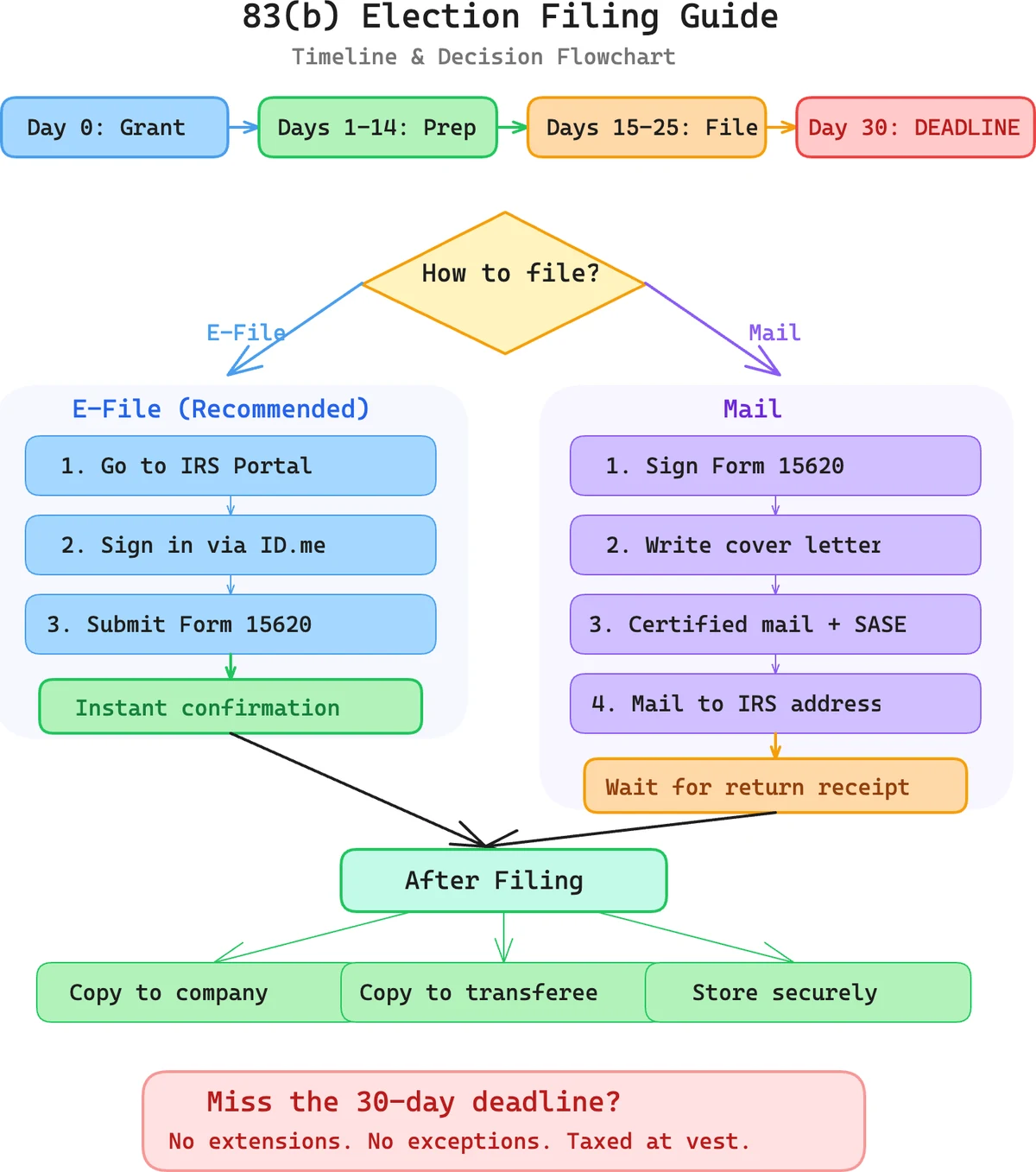
You have two options for submitting your 83(b) election: electronically through the IRS online portal, or by mail.
Option A: File Electronically (Recommended)
Since July 2025, the IRS accepts 83(b) elections through their online portal. This is now the preferred method because you get instant confirmation of receipt, which eliminates the risk of lost mail and removes the need for certified mail tracking.
To file electronically:
- Go to the IRS online filing portal for Form 15620
- Create or sign in to your IRS account using ID.me (the IRS multifactor authentication platform)
- Complete Form 15620 on the IRS website
- Submit the form electronically
- Download or print your confirmation and a copy of the filed form
One important note: only use one submission method. If you file electronically, do not also mail a copy. The online process will ask you to confirm that you have not mailed the form separately.
Option B: File by Mail
If you prefer to mail your election, this process still works. It just requires more attention to detail and proof of timely filing.
Prepare your mailing package:
- Original signed Form 15620 (or written 83(b) election statement)
- A cover letter (template provided below)
- One copy of the signed election form
- A self-addressed stamped return envelope (so the IRS can send back a stamped copy as acknowledgment)
Use certified mail with return receipt requested. This is your official proof of timely filing. Write the certified mail tracking number on your cover letter. Keep the receipt with your copy of the election form.
IRS Mailing Addresses
Mail your 83(b) election to the IRS office where you would normally file your federal income tax return. The IRS maintains a full list of filing addresses by state.
If your filing state is California:
| Scenario | Mailing Address |
|---|---|
| No payment enclosed (typical for 83(b)) | Department of the Treasury, Internal Revenue Service, Ogden, UT 84201-0002 |
| Enclosing a payment | Internal Revenue Service, P.O. Box 931000, Louisville, KY 40293-1000 |
| Using FedEx or UPS (Private Delivery Service) | Ogden - Internal Revenue Submission Processing Center, 1973 Rulon White Blvd., Ogden, UT 84201 |
For other states, check the IRS where-to-file page to find the correct address for your location.
Step 3: Distribute and Store Your Copies
After submitting your election to the IRS (whether electronically or by mail), you still have obligations:
- Send a copy to your company. Your employer needs this for compliance with securities regulations, including Rule 144 reporting. If your company issues ISOs, they have their own reporting obligations such as issuing Form 3921 to employees who exercise.
- If the transferee of the property is a different person than you (for example, if shares were transferred to a trust or corporation), provide a copy to the transferee as well.
- Store your personal copy securely. Keep it with your tax records alongside your certified mail receipt (if you filed by mail) or your electronic confirmation (if you filed online). You may need to reference this if the IRS ever questions your filing.
The 30-Day Deadline You Cannot Miss
The 83(b) election deadline is absolute. Your election must be filed with the IRS within 30 days of the date your restricted stock was granted or the date you exercised early. There are no extensions. There are no exceptions. There are no do-overs.
If you miss the deadline, you lose the election for that grant permanently. That means you will be taxed on the value of your shares as they vest, not at the value when they were granted. If your company’s valuation increases during your vesting period, the tax difference can be enormous. Depending on your grant type, missing the election could also trigger the Alternative Minimum Tax (AMT).
What founders and early employees need to understand: the 30-day clock starts on the date the board approves the grant, not the date you receive the paperwork. This creates a dangerously short window. If the board approved your grant on January 5 and you receive the documents on January 20, you only have 15 days left. An accurate, well-managed cap table is critical here because it provides a single source of truth for grant dates so there is no confusion about when your deadline falls.
Cover Letter Template
If you are filing by mail, include a cover letter with your election. Here is a template:
[Your Name] [Street Address] [City, State ZIP] [Phone] | [Email] [SSN/TIN: XXX-XX-XXXX]
[Date]
Internal Revenue Service [IRS Service Center address for your state - see address table above]
Re: Section 83(b) Election (IRC Section 83(b))
To Whom It May Concern:
Enclosed please find my signed election under Internal Revenue Code Section 83(b) with respect to property transferred to me on [Grant Date] by [Company Legal Name], EIN [XX-XXXXXXX].
This election is being submitted within 30 days of the transfer. Sent via USPS Certified Mail, Return Receipt Requested, tracking number [____________].
Enclosures:
- Original signed Section 83(b) election
- Copy of Section 83(b) election
- Self-addressed stamped return envelope
Sincerely,
[Signature] [Printed Name]
Filing Checklist
Use this checklist to make sure you do not miss anything:
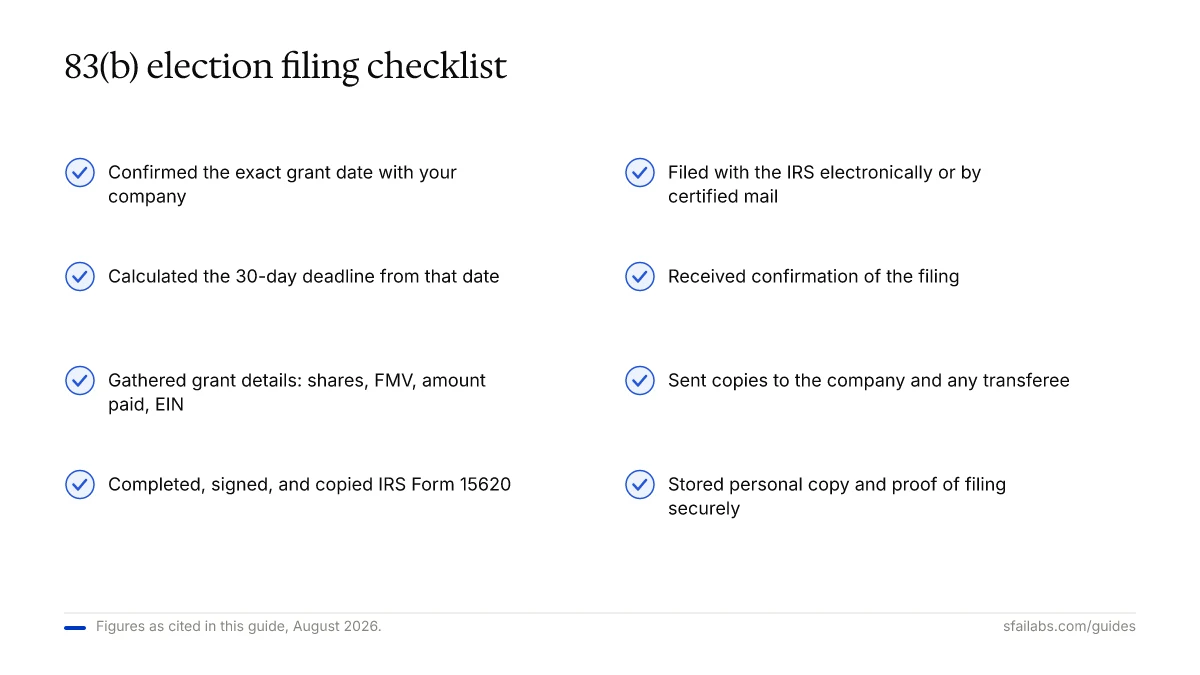
- Confirmed the exact grant date (board approval date) with your company
- Calculated the 30-day deadline from that date
- Gathered all required grant details (shares, FMV, amount paid, company EIN)
- Completed and signed IRS Form 15620
- Made at least three copies of the signed form
- Filed with the IRS (electronically or by certified mail)
- Received confirmation (electronic receipt or certified mail return receipt)
- Sent a copy to your company
- Sent a copy to the transferee (if applicable)
- Stored your personal copy and proof of filing in a safe place
Frequently Asked Questions
Can I file my 83(b) election electronically?
Yes. Since July 2025, the IRS accepts electronic submissions of Form 15620 through their online portal. You need an IRS account authenticated through ID.me. Electronic filing provides instant confirmation and is now the IRS preferred method.
What happens if I miss the 30-day deadline?
You permanently lose the ability to make the election for that grant. There are no extensions or exceptions. You will be taxed on the value of your shares as they vest rather than at the grant date value.
Do I need to attach the 83(b) election to my tax return?
No. As of 2015, the IRS eliminated the requirement to attach a copy of the election to your annual tax return. You only need to file it with the IRS within 30 days and provide copies to your company and any transferee.
Can a corporation or trust file an 83(b) election?
Non-individual purchasers such as corporations or trusts should consult legal and tax professionals licensed in their jurisdiction. The process involves additional considerations beyond the standard individual filing.
Should I talk to a tax professional before filing?
Yes. While the filing process itself is straightforward, the decision of whether to make an 83(b) election depends on your specific financial situation, the type of equity you hold, and your expectations for the company growth. A qualified tax professional can help you evaluate whether the election makes sense for your circumstances.
Key Takeaways
- An 83(b) election lets you pay taxes on restricted stock at today’s value instead of the potentially higher value when shares vest
- You have exactly 30 days from the grant date to file with no extensions or exceptions
- The IRS now accepts electronic filing through their online portal using Form 15620, which provides instant confirmation
- If filing by mail, use certified mail with return receipt requested as your proof of timely filing
- Send copies to your company and any transferee after filing
- The grant date is the board approval date, not the date you receive the paperwork so confirm this immediately
- Consult a tax professional before filing to evaluate whether the election is right for your situation
SFAI Labs