AI coding tools in 2026 are not one dial of autonomy — they are five, and frontier models score very differently on each. Inline completion is essentially solved; multi-step agentic work is partial and brittle; fully autonomous “AI engineer in a box” work is theatre on non-trivial codebases. SWE-Bench Verified, where Claude Opus, GPT-5, and Gemini 2.5 Pro cluster between 65% and 75% on a curated subset of well-specified GitHub issues, sets the ceiling — and a founder’s own codebase sits well below it. The right question is not “are AI coding tools autonomous?” but “autonomous at which task, against which benchmark, for which codebase?”
This piece builds on The DIY-with-AI manifesto, within the broader idea-to-product manifesto. Companion guides go deeper on the products — the 2026 AI coding tools buyer’s map, can a non-developer ship with Claude Code, vibe-coding explained — and AI model selection 101 covers the model layer.
Table of Contents
Why “autonomous” is the wrong question
The word “autonomous” carries a binary. Either the tool drives the car or it does not. That binary does not match what the tools actually do.
A 2026 AI coding tool may complete a single line with very high reliability, draft a multi-file refactor with moderate reliability, and attempt an unattended four-hour build with low and unpredictable reliability — all on the same day, with the same model behind it. Calling that mix “autonomous” or “not” loses the information that matters.
The replacement question is operational: at which axis of autonomy does this tool perform well today, and which axes are still partial? The five-axis framing below is the answer most vendor pages skip.
The five axes of AI coding autonomy
Across the practitioner literature, vendor docs, and benchmark papers, five operational levels recur. Treat them as a ladder — higher rungs depend on the lower ones holding up, and adding rungs adds failure modes faster than capabilities.
| Axis | What it means | Typical product | Founder analogue |
|---|---|---|---|
| 1. Chat-only | The model answers questions about code in a conversation. No file access, no editing. | ChatGPT, Claude.ai, Gemini app | A senior engineer on Slack |
| 2. Suggest | The model proposes changes the human accepts or rejects in-IDE. | GitHub Copilot, Cursor (Tab) | A pair-programmer leaning over your shoulder |
| 3. Inline-complete | The model completes the next chunk as you type, learning the local file and project context. | Cursor (Composer-light), Copilot Chat | A very fast autocomplete with codebase awareness |
| 4. Multi-step | The model plans, edits across multiple files, runs tests or commands, and iterates inside a defined task envelope. | Cursor Agent, Claude Code (short tasks), Replit Agent | A junior engineer working a ticket under review |
| 5. Autonomous | The model takes a high-level goal, decomposes it, runs for minutes-to-hours unattended, and ships a verified result. | Claude Code (long tasks), Codex/Devin-class agents | A mid-level engineer running solo overnight |
Axes 1 and 2 have been solved since 2023. Axis 3 became reliable through 2024 and is now table stakes — Stack Overflow’s 2025 Developer Survey reports that a majority of developers who use AI tools do so every working day (survey.stackoverflow.co/2025). Axes 4 and 5 are where 2025–2026 progress concentrates, and where the variance between models, codebases, and tasks is largest.
What the frontier models actually score on SWE-Bench Verified
SWE-Bench is the canonical benchmark for the upper rungs of the ladder. The original paper from Jimenez et al. — SWE-Bench: Can Language Models Resolve Real-World GitHub Issues? — pulls 2,294 real GitHub issues from 12 popular Python repositories and asks the model to produce a patch that passes the project’s hidden test suite.
SWE-Bench Verified is OpenAI’s curated 500-instance subset of that benchmark, filtered by human raters for tasks that are well-specified, scope-bounded, and have non-broken tests (introducing SWE-Bench Verified). Verified is the metric every frontier lab cites when claiming agentic-coding ability, because it removes the most noisy and ambiguous tickets from the original benchmark.
The 2025–2026 picture, drawn from vendor system cards and launch posts:
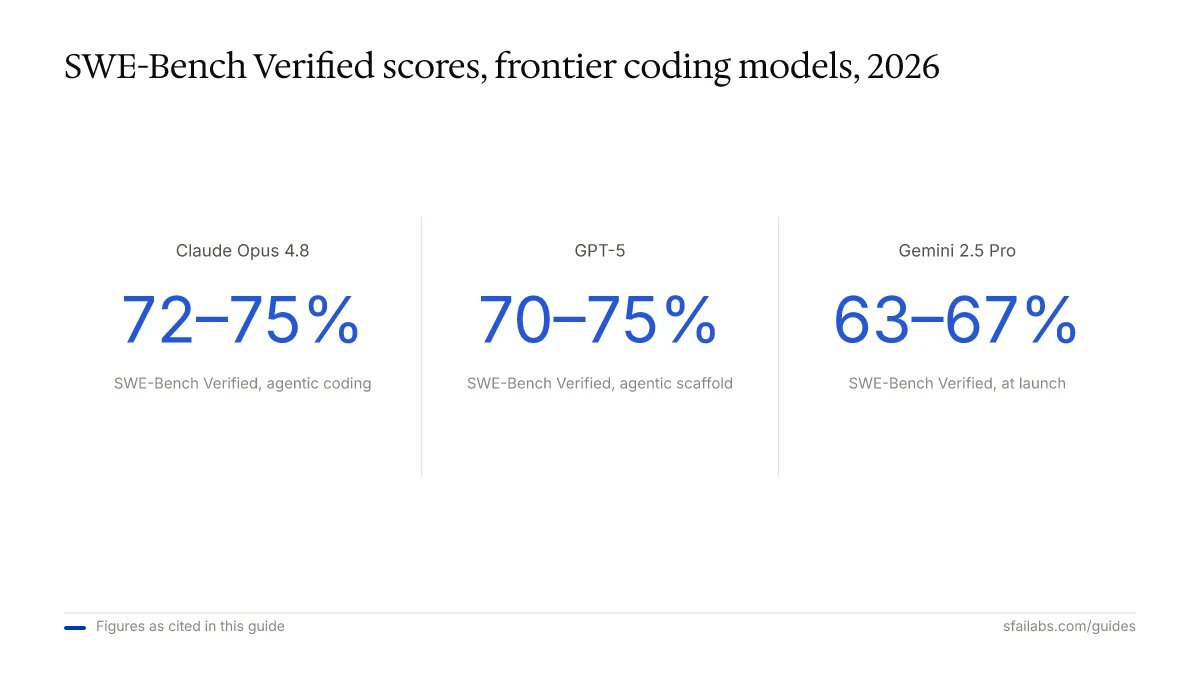
- Anthropic Claude Opus 4.8 — published a SWE-Bench Verified score in the 72–75% band on agentic coding workflows (Anthropic, Claude Opus 4.8). Anthropic’s earlier Claude 4 series report describes the underlying agentic-coding architecture (Anthropic, Claude 4).
- OpenAI GPT-5 — published SWE-Bench Verified results in the 70–75% band with their agentic scaffold (OpenAI, introducing GPT-5).
- Google Gemini 2.5 Pro — coding reports place it in roughly the 63–67% band on SWE-Bench Verified at launch (Google DeepMind, Gemini 2.5 Pro).
Quoting precise running numbers is risky because vendors update scaffolds and re-publish almost monthly. The shape is what matters: by mid-2026, the three frontier families cluster between roughly 65% and 75% on SWE-Bench Verified, with Anthropic and OpenAI trading the top spot and Google a few points behind on this specific benchmark.
Two adjacent benchmarks tighten the picture. Terminal-Bench — Anthropic’s agentic-coding benchmark covering real terminal tasks (tbench.ai) — runs substantially lower than SWE-Bench Verified, because terminal work spans environment setup, dependency management, and recovery from real shell errors. LiveCodeBench — UC Berkeley’s contamination-controlled benchmark (livecodebench.github.io) — adds problems continuously to avoid training-data leakage, and tends to spread frontier models further apart.
Read together: frontier models resolve a majority of well-specified, scope-bounded coding issues today; they still fail a substantial minority of those; and they fail much more often when tasks are poorly specified or sit inside a codebase the model has never seen.
Why the benchmark ceiling overstates real-world autonomy
A 74% on SWE-Bench Verified does not mean an AI tool will autonomously close 74% of your tickets. The benchmark has three structural advantages over your codebase, each of which lifts the score.
Curation. SWE-Bench Verified was filtered by human raters for tasks that are well-specified with non-broken tests. Your tickets were not. The unverified SWE-Bench score drops by roughly ten points or more, and unverified is still curated open-source Python with public tests — a higher-quality slice than founder reality (release notes).
Scope-boundedness. A Verified issue is one bug or one feature with a single test file as the success contract. Founder tickets are often unscoped — “make the dashboard faster” or “the agent breaks on this conversation type.” Multi-step agents are built for scope-bounded tasks and degrade when scope is fuzzy.
Familiarity. Frontier models have seen most popular open-source repositories in training. Your private codebase and bespoke architecture are not in pretraining. Long-horizon autonomy studies (METR and others) consistently show worse performance on unfamiliar codebases (METR).
The honest translation: a model scoring 74% on Verified, run autonomously on a small unfamiliar codebase, points to a working assumption closer to 40–55% one-shot resolution on well-specified tickets — lower on fuzzy ones. Still useful. Not the headline number.
Where founders overestimate autonomy
Three predictable misreads inflate founder expectations of axis 4 and 5 autonomy.
The demo-to-real-codebase gap. A YouTube demo of Cursor Agent or Claude Code building a clone of a famous app is engaging and almost entirely uninformative about how the same tool will perform on the founder’s own product. Clone-of-famous-app tasks sit at the centre of the pretraining distribution — the model has seen the architecture many times. The founder’s product does not.
The autonomous-PR fantasy. Vendor demos show an agent opening a pull request unattended. The demos are real. What they do not show is the failure rate when the same agent runs a hundred times. Long-task autonomy analyses (METR, Anthropic’s Claude 4 write-ups) put non-trivial autonomous-PR success rates well below the impression a single demo gives.
The “AI replaces engineers” misread. GitHub’s Octoverse 2025 reports that AI-assisted commits have grown explosively and that solo-founder-shaped accounts are the fastest-growing cohort (github.blog/news-insights/octoverse) — but the same data reveals that the most productive AI users are professional developers. Senior engineers using the same tools are pulling further ahead. The right phrase is engineer-amplifying, not engineer-replacing.
Where founders underestimate autonomy
The opposite misread is equally common — and matters more for non-technical founders, because the underestimated capabilities are the ones they could actually deploy today.
The silent compounding of inline-complete. Axis 3 — autocomplete with codebase context — has compounded into a productivity gain so steady that practitioners stop noticing it. Stack Overflow’s 2025 survey shows the largest reported productivity gains among novice developers and non-engineers, where the baseline-to-AI delta is largest (Stack Overflow 2025). Axis 3 is the rung that has paid off and continues to.
Long-task gains on routine refactors. Axis 4 is much better than the binary question implies for a specific shape of work: routine refactors, test-writing, dependency upgrades, dead-code removal, small-feature additions on existing patterns. This work is in-distribution for SWE-Bench Verified and is exactly what a non-technical founder should hand to an agent rather than a freelancer’s hourly rate.
Eval-and-test-running as a superpower. A frontier agent that can run a test suite, read output, and iterate is qualitatively different from a suggest-only model. The 2026 agents close a tight loop — write, run, read failures, fix — that replicates a chunk of junior-engineer work. A founder who never gives the agent test access is buying axis 2 capabilities at axis 4 prices.
A founder’s working verdict
The 2026 honest reading of the five axes, written for a non-technical founder choosing how to spend their attention:
- Axes 1–3 work today. Use them. Lean on Cursor Tab, Copilot, ChatGPT-class chat for code questions. The compounding gain is real and the failure mode is bounded.
- Axis 4 works on the right tasks. Hand Claude Code or Cursor Agent scope-bounded, in-distribution work — refactors, tests, well-specified features. Run with tests visible. Review before merge. Treat as a junior engineer under review, not as a deploy-ready output.
- Axis 5 is not yet a tool you can buy. Long autonomous runs on a founder’s own non-trivial codebase are still partial and brittle. The vendor demos are real on curated tasks and theatre on yours. Budget for the senior-engineer reviewer pattern described in the DIY-with-AI manifesto.
- Model choice matters less than tool choice. Frontier model parity on SWE-Bench Verified is close enough that the difference is dominated by the scaffold and the user’s discipline. The model selection 101 piece walks the model-layer decision separately.
- Token cost is a real constraint at axis 4–5. A founder running Claude Code in agentic mode for long sessions will see API bills measured in hundreds of dollars per month, not the $20 a Cursor subscription costs. Plan for it.
The simplest founder rule is the most accurate one: trust the lower rungs of the autonomy ladder, treat axis 4 as productive with a review gate, and read axis 5 vendor demos as marketing until the same demo runs on your codebase, twice, unattended.
Frequently Asked Questions
How autonomous are AI coding tools in 2026, in one sentence?
Roughly 65–75% effective on curated, well-specified coding tasks (SWE-Bench Verified), substantially less on messier real work, and not yet capable of unattended end-to-end production builds on non-trivial codebases.
What is SWE-Bench Verified and why does it matter?
SWE-Bench Verified is OpenAI’s 500-instance subset of the original SWE-Bench benchmark, hand-rated for well-specified tasks with working tests. Every frontier lab cites it because it gives a cleaner signal of agentic coding ability. It is the closest thing to a shared scoreboard.
Does Claude Opus or GPT-5 score higher on SWE-Bench Verified?
They trade the top spot. Anthropic’s published Claude Opus 4.8 score sits in the low-to-mid 70s (Anthropic); GPT-5’s published score sits in a similar band (OpenAI). The few-point gap matters less than the scaffold the tool wraps the model in.
Can I run an AI coding tool unattended overnight on my MVP?
You can — the question is what comes back. On in-distribution tasks with strong tests, the agent often finishes successfully. On a private codebase with fuzzy tickets and incomplete tests, the unattended overnight pattern produces high token bills and unpredictable results. A senior reviewer in the morning is the missing piece.
How does Gemini 2.5 Pro compare on autonomous coding?
On SWE-Bench Verified, Gemini 2.5 Pro sits a few points behind the leaders (Google DeepMind). On broader evaluations, especially long-context tasks that benefit from reading very large codebases in one shot, it is competitive. Pick by task shape, not leaderboard rank.
What is the difference between SWE-Bench, Terminal-Bench, and LiveCodeBench?
SWE-Bench measures real GitHub-issue resolution. Terminal-Bench measures terminal-level agentic work — dependency installs, environment setup, command execution. LiveCodeBench measures coding under contamination control, so training-set leakage cannot inflate scores. Read all three to see autonomy from different angles.
How much does it cost to run a frontier model in autonomous mode?
Cursor and Copilot subscriptions sit at $20–80 per month per seat. Claude Code or Codex-class agents in autonomous mode run from low tens of dollars in week one to several hundred dollars per month at steady state. Token spend tracks session length and codebase size, not feature count.
Will AI coding tools replace engineers in 2026?
No. The benchmark data and the Stack Overflow 2025 Developer Survey point the other way — senior engineers using AI tools pull further ahead of solo-AI-only workflows, not displaced by them. The framing is engineer-amplifying, not engineer-replacing.
Where should I start if I want to feel the autonomy gradient myself?
Three hours of paired use. The first hour in Cursor with Tab on, the second in Claude Code on a scope-bounded refactor with tests, the third reviewing what each produced. The gap between axes 3 and 4 — and between axis 4 and the axis 5 pitch — becomes obvious in one afternoon. The vibe-coding explainer names the patterns that work and the ones that fail.
Closing
The honest answer to “how autonomous are AI coding tools today” is a five-line answer, not a one-line one. Axes 1 through 3 are solved. Axis 4 is productive with discipline. Axis 5 is not yet a tool you can buy for a founder’s codebase. Treat the autonomy ladder as a working tool, not a marketing claim — the question stops being “is it autonomous?” and starts being “autonomous at which rung, and what do I owe the rungs above?”
For the broader take on when DIY-with-AI tools are enough, the DIY-with-AI manifesto names the failure modes and the third path most founders never hear about. The idea-to-product manifesto connects this to the full build journey.
Dirk Jan van Veen, PhD