A lease abstraction automation project for a commercial real estate firm of 4–20 people runs through five phases — discovery, proof of concept, pilot, production build, and rollout — and a well-scoped one reaches daily use in roughly eight to twelve weeks for a build cost in the $25,000 to $90,000 range. The reason most principals get the shape of this project wrong is that they picture it as one big software purchase with a single price and a single go-live date. It is not. It is a sequence of small commitments, each with its own deliverable and its own exit, and the two cheapest phases at the front — a proof of concept and a pilot — are precisely what stop a small firm from over-committing to the expensive part at the back. This is the phase-by-phase map: what happens, how long each stage takes, what it costs, and where you get to stop.
The five phases at a glance
Every honest lease abstraction automation project has the same skeleton. The names vary by vendor, but the sequence does not, because each phase exists to answer one question before you spend on the next.
| Phase | What it produces | Realistic elapsed time | Budget slice | The gate |
|---|---|---|---|---|
| 1. Discovery and scoping | A defined field set, document sample, and success target | 1–2 weeks | Often free or folded into the build | Do we agree on what “done” means? |
| 2. Proof of concept | An accuracy number on your hardest documents | A few days to 2 weeks | Small or bundled into the pilot | Does it read our leases well enough? |
| 3. Pilot | One document type, run against real files, measured | 2–4 weeks | $25,000–$45,000 | Is the result worth funding a build? |
| 4. Production build | A live workflow with review and export | 3–6 weeks | $45,000–$90,000 | Does the team actually use it? |
| 5. Rollout and handover | Trained staff, documentation, a maintenance plan | 1–2 weeks | Bundled or a small support retainer | Can we run this without the builder? |
Two things to read off this table before the detail. First, the money is back-loaded: the two front phases are cheap or bundled, and the large check does not get written until a pilot has produced a real accuracy number on your own files. Second, the elapsed times overlap and compress — a focused single-workflow automation can go from signature to daily use in six to ten weeks when the documents are standard, and stretch past twelve when they are not. For the full cost picture behind these ranges, our breakdown of what a custom document automation project costs prices each line in detail.
Phase 1: Discovery and scoping
Deliverable: a written agreement on the field set, a representative document sample, and a numeric success target. Time: one to two weeks. Cost: usually free or folded into the build fee.
This is the phase principals want to skip and the one that decides whether the rest goes well. The work is unglamorous: deciding exactly which fields you need pulled from a lease — commencement and expiration dates, base rent and escalations, renewal options, CAM terms, co-tenancy and exclusivity clauses — and, just as important, which ones you do not. Every field you add is scope, and scope is time and money. A firm that scopes twelve fields it actually uses will ship faster and cheaper than one that scopes forty “just in case.”
The second output is a sample of your real documents, ideally your messiest ones — the eighty-page lease with a stack of amendments, the scanned PDF from 2009, the nonstandard form a landlord’s counsel drafted. The third is the success target: the accuracy level and the per-lease time you would accept as a win. Without a number written down before anyone builds anything, “good enough” becomes an argument later instead of a checkbox. The scoping decisions here map directly onto the workflows described in our document intelligence playbook, which is the best place to pressure-test whether your field set is complete.
The gate: you and the builder agree, in writing, on what “done” looks like. If you cannot get to that agreement, do not proceed — a project with an undefined finish line is the most reliable way to overspend.
Phase 2: Proof of concept
Deliverable: an accuracy number produced by running an extraction against your hardest documents, with no integration attached. Time: a few days to two weeks. Cost: small, and frequently bundled into the pilot.
A proof of concept answers one narrow question: can the system read your worst leases well enough to be worth pursuing? It deliberately skips everything hard — no connection to your rent roll, no review interface, no polish. Someone runs your sample documents through the extraction and shows you the output next to the source so you can see where it nails a rent escalation and where it fumbles a hand-annotated clause.
This step matters because raw extraction is less impressive than vendor demos suggest. On messy real-world leases, initial extraction commonly lands around 70 to 75 percent accuracy before any tuning, and reaches the mid-90s only with verification and iteration (Unframe; Kolena). Seeing that gap on your own documents, early and cheaply, is the point. A demo on a vendor’s clean sample tells you nothing; a proof of concept on your files tells you everything.
The gate: the extraction clears a bar you can live with on the documents you actually have. If it cannot read your leases at a plausible accuracy after reasonable effort, you have learned that for a few days of work instead of a six-figure build.
Phase 3: The pilot
Deliverable: one document type, one field set, run end to end against a real batch of your files, with a measured accuracy and time result. Time: two to four weeks. Cost: $25,000 to $45,000.
The pilot is where the project becomes real and where the first meaningful check gets written. It takes a single document type — leases, not leases-plus-amendments-plus-estoppels — and runs a representative batch of 50 to 100 of your files all the way through, producing structured output you can inspect field by field. Unlike the proof of concept, the pilot measures at something close to production conditions: a real batch, a real field set, and a real number for how long each lease takes with a human confirming the low-confidence fields.
The industry benchmark you are testing against is stark. Manual abstraction of a standard 30-to-50-page commercial lease takes an experienced analyst three to eight hours at a labor cost of roughly $150 to $400, or $200 to $600 outsourced. A tuned AI workflow reaches 95 percent-plus accuracy on standard fields with verification and cuts per-lease time to about 17 minutes including the human check (Kolena). The pilot’s job is to confirm those numbers hold on your leases, not a case study’s.
The gate: the pilot result is good enough, on your files, that funding a production build is an obvious yes. If the number is marginal, you stop here having spent pilot money, not build money. This is the single most important discipline in the whole project.
Phase 4: The production build
Deliverable: a live workflow — extraction, a review queue where staff correct low-confidence fields, and a clean export into your system of record. Time: three to six weeks. Cost: $45,000 to $90,000.
This is the phase that changes how the office works, and it is the largest budget slice. A production build takes the proven pilot and turns it into something your team runs every week without a developer in the loop. Three things get built that the pilot skipped. First, a review interface: extraction at 95 percent still means one field in twenty needs a human eye, and on a lease that field might be a rent escalation you cannot afford to get wrong, so the workflow flags what it is unsure about and routes it to a person. Second, the export: getting structured output into your rent-roll spreadsheet or a management platform such as Yardi or AppFolio. Third, the operational scaffolding — error handling, logging, and the ability to reprocess a document when something looks off.
The cost swing inside this range is driven almost entirely by two variables: how standard your documents are, and how demanding the integration is. A one-way push into a spreadsheet keeps you near the floor; a two-way sync into a platform with its own quirks pushes you toward the ceiling. If you are still weighing whether this build is the right move against buying a product, our framework for off-the-shelf document AI versus custom pipelines is the decision to settle before this phase starts.
The gate: the team uses it. A build that ships but sits unused is a failure regardless of how well it extracts — which is why the next phase exists.
Phase 5: Rollout and handover
Deliverable: trained staff, written documentation, and a maintenance plan. Time: one to two weeks. Cost: bundled, or a small ongoing support retainer.
The last phase is the one that gets cut when a project runs late, and cutting it is how a working system quietly dies by the next fiscal year. Rollout means the people who will actually run the workflow are trained on it — not just shown a demo — and know what to do when a document does not extract cleanly. Handover means documentation exists and someone at your firm owns the system, so you are not calling the builder every time a landlord sends a lease in a new format.
It also means agreeing on maintenance. A custom pipeline is a living system: document formats change, the underlying models get updated, and an integration breaks when a vendor ships a new version. Budgeting roughly 15 to 20 percent of the build cost per year for upkeep is the difference between a system that works in month one and one that still works in month eighteen. A lean firm’s real advantage is speed of adoption, an argument we make in full in the small CRE firm AI manifesto.
The gate: you can run the workflow without the builder in the room. That is the definition of done.
Where the risk actually lives
The instinct is to worry about extraction accuracy — whether the AI is “smart enough.” That is rarely what sinks these projects. The failures cluster around workflow and integration: getting the output into your systems, fitting the review step into how staff actually work, and handling the messy documents that do not match the happy path. As one analysis of stalled lease abstraction rollouts puts it plainly, pilots fail when teams focus on the technology over the workflow (Unframe).
The macro numbers confirm the pattern. JLL’s 2025 Global Real Estate Technology Survey found roughly 88 percent of real estate investors piloting AI, yet only about 5 percent reported achieving all of their goals — a gap that is about disciplined scoping and adoption, not smarter models. Deloitte’s 2026 Commercial Real Estate Outlook, drawn from more than 850 executives, frames AI capability as a board-level priority precisely because so many firms struggle to convert pilots into production. The lesson for a small firm is to spend your scrutiny on the boring parts — the export, the review queue, the handover — because that is where the money is won or lost. For the per-lease economics that sit underneath all of this, see our analysis of what automated lease abstraction actually costs in 2026.
When this project should not happen
An honest anatomy has to include the case where you do not run the project at all. A custom build earns its cost only when your documents are nonstandard enough that off-the-shelf accuracy forces expensive cleanup, your volume is high enough that per-document fees overtake a build, or your output requirements are specific enough that no product exports what you need. If none of those hold, the project ends at Phase 1.
Off-the-shelf AI abstraction runs roughly $20 to $100 per lease including quality review, and lease-management platforms such as Prophia and Leasecake fold document handling into a broader subscription. Run the arithmetic: at $50 a lease, 200 leases a year is $10,000 — a fraction of even a pilot. And if your leases are standard and your fields are common, a well-prompted general-purpose assistant like ChatGPT or Claude may clear the bottleneck for the price of a subscription. The discovery phase should tell you honestly which world you are in. Reserve a custom project for the workflows where a product genuinely cannot do the job.
A worked timeline and budget
Ranges become useful when they are a single plan. Here is how a realistic first engagement sequences for a 10-person firm abstracting a few hundred leases a year, choosing to build because its lease forms are nonstandard.
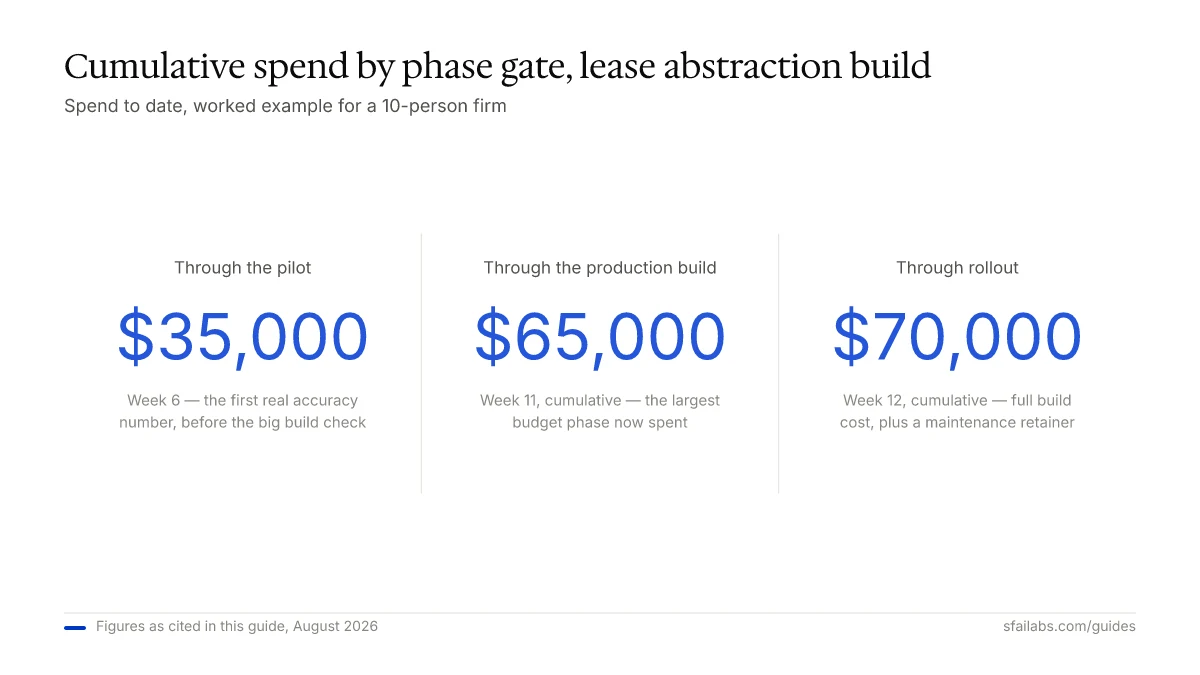
| Week | Phase | Spend to date |
|---|---|---|
| 1–2 | Discovery and scoping | $0 (bundled) |
| 2–3 | Proof of concept | small / bundled |
| 3–6 | Pilot (one document type) | ~$35,000 |
| 6–11 | Production build | ~$65,000 cumulative |
| 11–12 | Rollout and handover | ~$70,000 cumulative, plus maintenance retainer |
The shape is the point. By week six you have spent pilot money and hold a real accuracy number; only then does the build check get written. If the pilot had come back marginal, you would have stopped near $35,000 instead of $70,000 — the whole reason the phases exist in that order. First-year maintenance adds roughly 15 to 20 percent of the build on top, and ongoing hosting and model usage scale with your document volume. These are market-rate estimates for planning, not a quote; a real number comes from scoping your actual documents.
FAQ
How long does a lease abstraction automation project take?
A well-scoped project for a small firm reaches daily use in about eight to twelve weeks: one to two weeks of discovery, a few days to two weeks of proof of concept, a two-to-four-week pilot, a three-to-six-week production build, and one to two weeks of rollout. Standard documents and a simple export land you at the short end; nonstandard leases and a two-way platform integration push past twelve weeks.
What does a lease abstraction automation project cost?
Budget $25,000 to $90,000 for a small-firm build, spent in stages: a pilot at $25,000 to $45,000 and a production build at $45,000 to $90,000, with discovery and proof of concept usually bundled or small. Add roughly 15 to 20 percent of the build cost per year for maintenance, plus hosting and model usage that scale with volume. A multi-document pipeline runs higher.
What are the phases of a lease abstraction automation project?
Five: discovery and scoping (define the fields and the success target), proof of concept (test extraction on your hardest documents), pilot (run one document type against a real batch and measure it), production build (add review and export for daily use), and rollout and handover (train staff and agree on maintenance). Each phase has a decision gate where you can stop.
Why start with a pilot instead of building the full system?
Because the pilot produces a real accuracy number on your own files for $25,000 to $45,000 before you commit to a $45,000-to-$90,000 build. If the result is marginal, you stop having spent pilot money, not build money. It is the single most effective discipline for keeping a document-automation budget from ballooning.
How accurate is AI lease abstraction?
A tuned AI workflow reaches 95 percent-plus accuracy on standard commercial lease fields with human verification, cutting per-lease time from three to eight hours to roughly 17 minutes. Raw extraction on messy documents often starts around 70 to 75 percent before tuning, which is exactly why a proof of concept on your real leases matters more than a vendor demo.
Do we still need people to review the output?
Yes. Even at 95 percent accuracy, about one field in twenty needs a human check, and on a lease that field might be a rent escalation or a renewal option you cannot get wrong. A production build includes a review queue that flags low-confidence fields so a person resolves them in seconds rather than re-reading the whole lease. The gain is faster review, not no review.
What is the biggest risk in a lease abstraction project?
Workflow and integration, not extraction accuracy. Projects stall on getting output into your systems, fitting review into how staff work, and handling documents that do not match the happy path. Industry data backs this up: most CRE firms piloting AI never reach full production, and the gap is disciplined scoping and adoption, not smarter models.
When should we buy a tool instead of building?
When your leases are standard, your fields are common, or your volume is low. Off-the-shelf abstraction runs about $20 to $100 per lease, and at a few hundred leases a year that is far cheaper than a build. A general-purpose assistant like ChatGPT or Claude may even suffice for standard leases. Build only when nonstandard documents, high volume, or specific output requirements make a product inadequate.
Who at our firm needs to be involved?
The person who owns the abstraction output — an ops director or the principal who relies on the data — should sit in discovery and sign off on the field set and success target, because they know what “correct” means. During rollout, whoever will run the workflow week to week needs hands-on training and ownership of the system, so the firm is not dependent on the builder for routine operation.
Key takeaways
- A lease abstraction automation project runs five phases — discovery, proof of concept, pilot, production build, rollout — reaching daily use in about eight to twelve weeks for a $25,000-to-$90,000 build.
- The money is back-loaded on purpose: cheap front-end phases produce an accuracy number on your own files before the large build check gets written.
- The two early gates — after the proof of concept and after the pilot — are what cap a small firm’s downside; use them.
- Most of the real risk lives in workflow and integration, not extraction accuracy, so scrutinize the export, the review queue, and the handover.
- If your leases are standard or your volume is low, the project may end at discovery: an off-the-shelf tool at $20 to $100 per lease often beats a build.
Want the timeline and budget for your actual documents instead of a range? A short conversation about your lease forms, your volume, and where the bottleneck really sits will scope this far better than any market average. Book your free AI-readiness assessment → and we will map what a lease abstraction project would take — and be worth — for your firm.
Arthur Wandzel