
The SaaS companies seeing real returns from AI are not the ones with the most ambitious roadmaps — they are the ones that picked specific, high-friction problems and shipped working solutions. Intercom’s Fin AI agent now autonomously resolves up to 65% of support conversations at Lightspeed Commerce. Notion crossed $500M in ARR after AI adoption among its customers jumped from under 20% to over 50% in 12 months. Canva reached $4B in recurring revenue at the end of 2025, driven in large part by 800 million monthly AI tool uses — up 700% year-over-year. These are not projections. They are published results.
This article documents what is working across customer support, churn prevention, product development, revenue forecasting, and content — grounded in named companies, specific tools, and reported numbers.
AI-Powered Customer Support: The Fastest Path to ROI
Support automation is where most SaaS companies should start because the economics are immediate and the tooling is mature. Intercom’s 2026 Customer Service Transformation Report found that 79% of support teams plan to increase AI investment in 2026, up from 76% in 2024 — a sign that early adopters validated the bet.
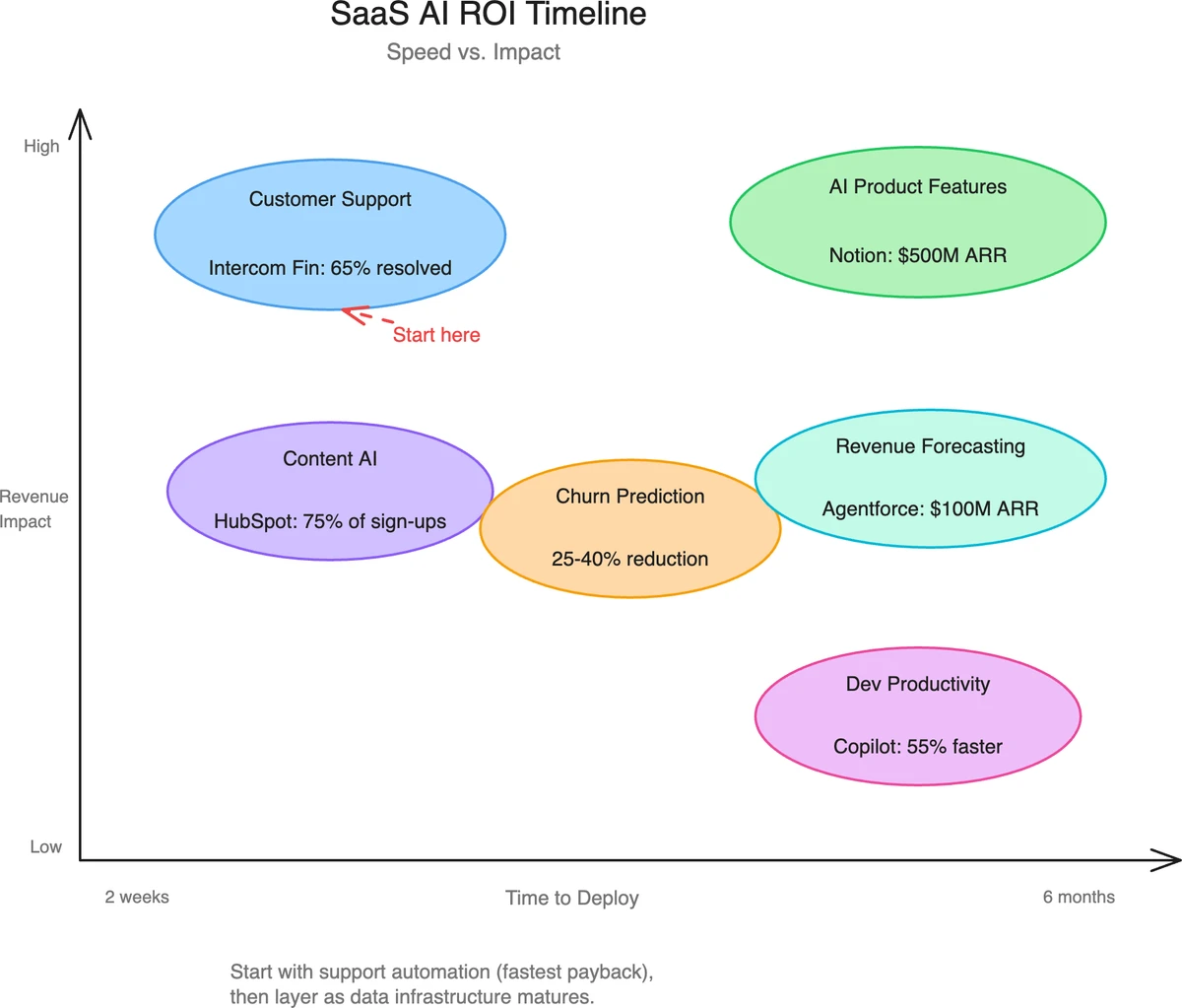
Intercom Fin: Resolving Two-Thirds of Tickets Without a Human
Fin, Intercom’s AI agent, achieves an average conversation resolution rate of 41% across its customer base. For Lightspeed Commerce, Fin participates in 99% of conversations and resolves 65% autonomously. For Tado°, the smart-home SaaS, Fin completes up to 70% of workflows and keeps CSAT near 90% during peak demand periods — the same periods that historically required expensive temporary hiring.
The cost calculus is straightforward. Human support agents handling general inquiries cost $5–$10 per resolution on average. Fin costs roughly $0.50–$1.50 per resolution at scale, depending on volume tier. For a SaaS company handling 10,000 support interactions per month, that difference compounds quickly.
Zendesk AI: 80%+ Deflection Rates in Configured Deployments
Zendesk AI Agent Advanced is built to handle 80%+ of interactions in properly configured deployments. The key phrase is “properly configured” — teams that invest in knowledge base quality and conversation flow design see materially better deflection rates than teams that treat AI setup as a one-time task.
Gartner data shows teams using AI-first support platforms see 60% higher ticket deflection rates and 40% faster response times compared to traditional help desks. HubSpot’s own support organization has applied this internally: their AI agents now resolve 35% of tickets, with a stated target of 50%+ resolution by end of 2025.
Churn Prediction: Catching Revenue Leaks 30-60 Days Early
SaaS churn prediction is a solved problem at the tooling layer. The companies that fail at it are not lacking models — they are lacking the clean behavioral data those models need to produce reliable signals.
How AI Churn Models Actually Work
Effective churn prediction aggregates signals across product usage, support ticket frequency and sentiment, billing history, email engagement, and renewal proximity. Machine learning models assign a risk score that updates in real time as new events arrive. The operational advantage over traditional cohort analysis is timing: AI models flag at-risk accounts 30–60 days before the renewal window, when customer success teams can still influence the outcome.
AI-powered churn prevention reduces customer loss by 25–40% compared to traditional methods, according to published benchmarks. Companies implementing real-time churn scoring see 35% improvement in retention campaign effectiveness. For a SaaS business with $2M ARR and 4% monthly churn, a 30% reduction in churn translates to roughly $240K in saved revenue annually.
Tools Deployed by SaaS Companies in Production
Gainsight, Totango, and ChurnZero are the established customer success platforms with embedded AI churn scoring. Funnelstory and Livex.ai offer more lightweight churn-prediction-specific tooling for companies under $5M ARR. The integration requirement in each case is the same: product event tracking, CRM data, and billing data need to flow into a unified model. Teams that skip this instrumentation work get noise, not signal.
Notion’s AI Bet: From Add-On to Core Revenue Driver
Notion’s trajectory is the clearest case study of AI transforming a SaaS company’s financial profile rather than just its product surface. In early 2024, 10–20% of Notion customers paid for AI features as an add-on. By mid-2025, that figure crossed 30–40%. By the time Notion crossed $500M ARR in late 2025, AI feature adoption had exceeded 50% of its customer base.
The mechanism was a customizable AI agent launched in 2025 that allowed teams to automate workflows directly inside their Notion workspace. Enterprise and AI tiers now drive more than 60% of Notion’s revenue — a structural shift from a product that was primarily sold on the strength of its organizational flexibility.
The lesson for SaaS founders is not “add AI.” It is that AI features that reduce time-to-outcome for the user’s core job create expansion revenue, not just feature parity. Notion’s AI reduces time spent structuring, searching, and summarizing information — the exact friction the product existed to solve.
Revenue Forecasting: Replacing Spreadsheet Intuition with Pipeline Data
Traditional sales forecasting achieves median accuracy between 70% and 79%. AI-powered forecasting increases that accuracy by up to 20 percentage points, according to multiple vendor studies and independent analyses. The practical difference for a $5M ARR company is the difference between confident capacity planning and reactive scrambling.
Gong, Clari, and What the Numbers Show
A documented case study of a 200-person enterprise sales team that migrated from a combined Gong and Clari stack to a unified AI revenue platform saved $300,000 annually while improving forecast accuracy by 20% and cutting administrative overhead by 75%. AI agents ingest CRM data, call recordings, email signals, and market context to produce deal-level risk scores and revenue predictions with scenario plans.
The productivity gain for individual reps is also material. Revenue intelligence automation saves sales representatives up to 20 hours per week in administrative tasks — time that shifts to pipeline generation and customer conversations. AI adoption among sales reps rose from 24% in 2023 to 43% in 2024, nearly doubling in a single year.
Salesforce Agentforce: $100M ARR in Its First Year
Salesforce launched Agentforce in October 2024. By the end of fiscal year 2025, it reported first-year ARR exceeding $100M. The Summer 2025 release added over 100 new features. Salesforce’s broader AI investment delivered CRM maintenance time reductions of 40% and data accuracy improvements of 95% in documented deployments using AI-native activity capture.
These numbers matter to SaaS founders because they confirm that AI in the sales workflow is not early-adopter territory. Your buyers are already working with AI-assisted sales processes on the other side of the table.
Canva’s AI Stack: $4B Revenue and What Actually Drove It
Canva’s path to $4B ARR at the end of 2025 is a case study in layered AI strategy. The company combined three components: its own foundation model (Phoenix) developed through the $370M acquisition of Leonardo AI in July 2025, native AI text, image, and video generation powered by OpenAI and Runway ML, and an ecosystem of 120+ specialized AI plugins.
Monthly active users reached 265 million by end of 2025, up from 180 million the prior year — a 47% increase. Paid users exceeded 31 million. The B2B segment (companies with 25+ seats) reached $500M ARR with 100% year-over-year growth.
The operational insight from Canva’s trajectory: AI features that reduce the time between intent and output — in Canva’s case, going from “I need a visual” to a finished asset — drive retention and expansion at rates that generic feature additions do not. The 800 million monthly AI tool uses reported in 2025 are not a vanity metric. Each use is a session where a customer solved a problem faster than they would have otherwise.
GitHub Copilot and AI Code Review: The Developer Productivity Evidence
GitHub Copilot surpassed 20 million all-time users as of July 2025. The productivity evidence from controlled studies and enterprise deployments is consistent: developers complete tasks 55% faster, pull request cycle time drops from 9.6 days to 2.4 days, and successful builds increase by 84% among active Copilot users. Copilot now writes approximately 46% of the average user’s code, reaching 61% in Java-heavy codebases.
For SaaS companies, the relevant number is not the individual productivity gain — it is the organizational throughput. A 10-person engineering team where each engineer ships 55% faster is not the equivalent of 15.5 engineers. But it is the equivalent of significantly faster feature cycles, shorter bug resolution windows, and faster responses to security patches. The AI coding tools market reached $7.37 billion in 2025, with GitHub Copilot holding 42% market share.
CodeRabbit, Tabnine, and Sourcery are production alternatives for teams that prefer not to route code through GitHub’s infrastructure. The category has matured enough that choosing between them is an implementation preference, not a capability compromise.
AI Pricing Optimization: The Gap Most SaaS Companies Have Not Closed
Only 37% of SaaS companies currently use any form of dynamic pricing, according to Profitwell survey data. McKinsey projected that by 2025, 65% of enterprise SaaS companies would implement some form of AI-driven personalized pricing — the gap between that projection and the 37% reality is the opportunity.
Companies using AI-driven pricing systems report revenue increases of 15–25% without losing customers to aggressive price changes. The Bain & Company finding that dynamic pricing improves company margins by 2–10% is consistent with observed outcomes across SaaS companies deploying usage-based pricing optimized with AI. Among the 23% of enterprise SaaS companies that have adopted machine learning-driven price optimization, the reported monetization efficiency improvement averages 18%.
The tooling options include Monetizely, Vayu, and custom implementations built on top of Stripe’s metered billing infrastructure. The prerequisite is granular usage telemetry — without it, AI pricing models have no signal to optimize against.
HubSpot Breeze AI: 75% of New Sign-Ups Driven by AI Features
HubSpot’s Breeze AI rollout produced a measurable acquisition effect: 75% of new HubSpot sign-ups in 2025 are attributed to AI-driven features including the Customer Agent. Content Hub attachment rates surged from 13% to 54% during 2024. Service Hub Enterprise portal adoption doubled quarter-over-quarter in Q4 2024, driven by Customer Agent capabilities.
For SaaS companies building on top of or integrating with HubSpot, this matters because it signals where the platform is investing and where buyer expectations are shifting. For SaaS companies with their own AI feature roadmaps, HubSpot’s trajectory illustrates how AI functionality can shift from a pricing add-on to a primary acquisition driver.
Frequently Asked Questions
What AI use case should a SaaS company implement first?
Customer support automation delivers the fastest ROI for most SaaS companies. Intercom Fin, Zendesk AI Agent Advanced, and similar tools deploy in 2–4 weeks and reduce per-resolution costs from $5–$10 (human) to under $1.50 (AI). For companies with high support volume and predictable inquiry types, the payback period is typically under six months. Start with support if your ticket volume exceeds 2,000 per month.
How much does AI implementation actually cost for a SaaS company?
Tool costs range from $500/month for lightweight support automation or churn scoring platforms to $5,000+/month for enterprise-grade solutions like Gainsight or Salesforce Agentforce. Implementation costs for a clean integration run $15,000–$40,000 depending on data infrastructure complexity. The total first-year cost for two to three use cases is typically $50,000–$120,000, against a documented return of $150,000–$400,000 in cost reduction or retained revenue for mid-market SaaS companies.
Do SaaS companies need a data scientist to implement AI use cases?
No, for the majority of production use cases. Intercom Fin, GitHub Copilot, HubSpot Breeze, and Gainsight all operate as configured SaaS tools rather than custom ML projects. You need engineers to handle integrations and product managers to define workflows. Custom model training — for proprietary churn models or pricing algorithms — does require data science capability, but most companies reach meaningful outcomes with off-the-shelf solutions first.
How do SaaS companies measure ROI on AI investments?
Measure against the specific metric the use case targets. Support automation: cost per resolution and ticket deflection rate. Churn prediction: monthly churn rate before and after intervention. Sales forecasting: forecast accuracy variance and rep hours saved. Code review AI: PR cycle time and bug escape rate. Each use case has a direct metric. Calculate ROI as (cost saved or revenue retained) minus (tool cost plus implementation cost), measured at 90 days and 12 months.
What is the risk of AI features cannibalizing existing SaaS revenue?
The documented risk runs the opposite direction. Notion’s AI add-on shifted from 10–20% customer adoption to over 50% adoption in 12 months, driving revenue growth rather than substituting for it. The risk is in poorly scoped AI features that add complexity without reducing customer effort — those erode NPS and increase support load. AI features that reduce time-to-value for the user’s primary job function consistently expand revenue.
How does AI churn prediction work in practice?
An AI churn model ingests behavioral data — login frequency, feature usage depth, support ticket volume and sentiment, payment history, and engagement with outbound communication. It assigns each account a risk score that updates daily or in real time as events arrive. Customer success teams receive a ranked list of at-risk accounts with intervention recommendations. The model improves over time by learning which interventions (pricing conversations, training sessions, feature unlocks) worked for accounts with similar risk profiles.
Which SaaS verticals see the highest ROI from AI?
Fintech, HR tech, and legal tech SaaS companies consistently report strong AI ROI because their core workflows involve high-volume, structured decisions where AI can replace manual review. Customer-facing SaaS in these verticals also benefits from support automation given the complexity of user questions. For horizontal SaaS tools — productivity, project management, CRM — AI adoption that reduces time-on-task for the primary use case (Notion’s approach) consistently outperforms AI features added at the periphery.
Key Takeaways
- Intercom Fin resolves 65% of conversations autonomously at Lightspeed Commerce and keeps CSAT near 90% at Tado° during peak periods — the support automation ROI is documented, not projected
- Notion grew from under 20% AI feature adoption to over 50% in 12 months, crossing $500M ARR; AI and enterprise tiers now drive more than 60% of revenue
- Canva reached $4B ARR at end of 2025 with 800M monthly AI tool uses, up 700% year-over-year, driven by a layered AI stack including its own foundation model via the $370M Leonardo AI acquisition
- GitHub Copilot users complete tasks 55% faster, PR cycle time drops from 9.6 to 2.4 days, and the tool now writes 46% of average user code across 20M+ active users
- AI-powered churn prediction reduces customer loss by 25–40% versus traditional methods; real-time churn scoring improves retention campaign effectiveness by 35%
- Only 37% of SaaS companies use dynamic pricing despite AI-driven pricing systems delivering 15–25% revenue increases without customer loss
- HubSpot attributes 75% of new sign-ups to AI-driven features, with Content Hub attachment rates rising from 13% to 54% in 2024
- Salesforce Agentforce crossed $100M ARR in its first year; AI-native CRM implementations show 40% reductions in maintenance time and 95% data accuracy improvements
- The fastest implementation path: customer support automation (2–4 weeks to deploy, under 6 months to payback) followed by churn prediction (4–8 weeks, requires clean behavioral data)
- AI use cases with the highest failure rate share a common cause: missing data infrastructure; tool selection is secondary to instrumentation quality
SFAI Labs