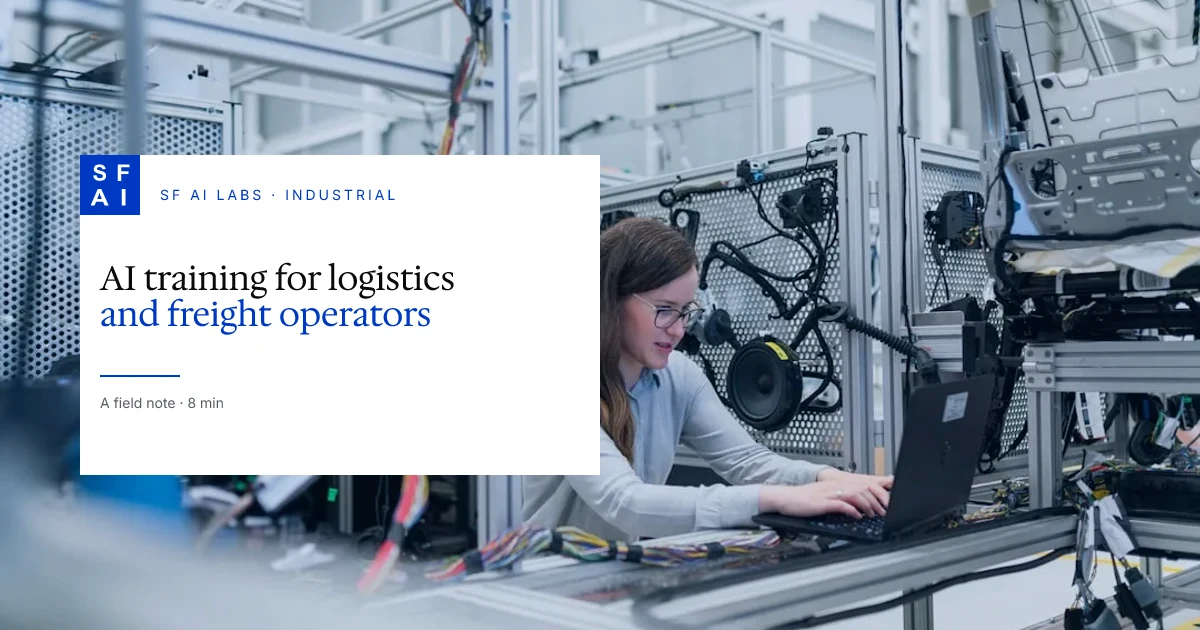
Search for AI training for logistics and the results teach demand forecasting, route optimization, warehouse computer vision, and predictive maintenance. Those are things a transportation management system vendor sells you, not skills your people learn in a room. A freight brokerage, a 3PL, a carrier, or a forwarder with 50 to 500 employees spends its day on text: tenders, spot quotes, carrier emails, detention threads, exception updates, claim narratives, rate confirmations. That is the AI-shaped work in freight, and almost nobody sells training for it.
The commercial pressure is already here. The 31st Annual Third-Party Logistics Study comes from NTT DATA, Penske Logistics, and the University of Tennessee’s Global Supply Chain Institute, with CSCMP support. It reports that 93% of shippers weigh AI capability when selecting a logistics provider, while only 12% of providers call themselves highly prepared to deliver AI-enabled operations. Your next RFP will ask. The question is what you buy before then.
Two different things wear the same name
“AI training for logistics” means two unrelated purchases. One trains a model on your freight data to predict a transit time. The other trains the employees on your desk to use the tools you already pay for. Most buyers want the second and get sold the first, because the catalogs were written for analysts. Three products hide behind one search term:
| You are buying | It looks like | It changes | It does not change |
|---|---|---|---|
| Analytical capability | Machine learning coursework, Python, a university certificate | What one or two analysts can build | How fifteen people handle Monday’s exception queue |
| A credential | Self-paced certificate, a badge, education credit | A résumé and a line in a bid response | Any recurring process |
| Team capability | Live sessions on the team’s own loads and files, then weeks of reinforcement | Cycle time on repeating work | Anyone’s credential status |
All three are legitimate buys. A planner who will own a transit-time model should take the analytics path; a manager collecting credit should buy the certificate. But if the goal is faster tender response and fewer evenings lost to carrier email, neither touches it. That third row is what AI enablement means in practice, and the function-by-function version sits in our playbook on why one company needs nine different curricula.
The largest operator in the industry has picked a lane: FedEx’s AI Education and Literacy program, announced in December 2025 for a workforce above 500,000, is role-based fluency, not data science. You do not need their budget to copy their shape.
The tiers, at verified October 2026 prices
Prices below come from each provider’s public pages as of October 2026. Catalogs change quarterly, so confirm before you approve anything.
| Option | Price | Shape | Who it suits |
|---|---|---|---|
| Coursera for Teams | $399 per user per year, 2 to 499 licenses | Self-paced library | Reinforcement after a live session |
| Community-college program | Two 8-week online courses, scholarships offered | Entry-level credential, placement help | Your hiring pipeline, not your desk |
| Corporate instructor-led course | Quoted per engagement | About 16 hours over two days: foundations, prompting, forecasting, exception reporting | A team that wants a packaged curriculum |
| MIT CTL executive week | $6,000 was the 2026 reference price | Five days on campus; machine learning, forecasting, computer vision, large language models | One leader who must filter vendor claims |
| Freight trade schools | From $599 for the DAT-partnered course to $2,495 for a five-day broker course | Brokerage mechanics, carrier compliance, sales | New brokers and dispatchers learning the trade |
Two things stand out. The MIT week is the most credible leadership option in the set, and nine of its ten modules are model-building topics a 40-person brokerage will never do. And the channel this industry trusts, the broker schools, teaches brokerage: how to sell, vet a carrier, stay compliant. AI shows up there as a marketing line, not as practice on your own rate confirmations.
The packaged corporate course comes closest to a real team session, and its module list is honest about where value sits. What it will not do is run on your loads, your claim backlog, or your carrier mix.
The text work a freight desk repeats every week
A session earns its cost only when it runs on work the team repeats next Tuesday. Five families recur across brokerages, 3PLs, asset carriers, and forwarders:
Tender and spot-quote replies. A bid lands in the shared mailbox with a lane, a commodity, and a window. Drafting the reply against your own rate history and terms is the highest-frequency text task in the building, and the one where speed wins the load.
Carrier and capacity correspondence. Sourcing emails, appointment requests, detention and accessorial disputes: short pieces of writing a dispatcher labors over at 6 p.m. Drafting from a prior thread turns twenty minutes into four.
Exception and track-and-trace updates. A truck is late, a door is closed, a load is short. Customers want a note saying what happened, what it means for their dock, and what you are doing. Teams either write these well or stop writing them, and silence loses the account.
Claim and OS&D narratives. Overage, shortage, and damage files turn on a clear account of events tied to documents. Drafting from the paperwork and editing beats writing from memory at shift end.
Field extraction from freight documents. Rate confirmations, bills of lading, delivery receipts, invoices, customs paperwork. Pulling named fields into one format is frequent, dull, and well suited to a model with a person checking the sample. The spot-check is the lesson here, not the extraction.
Leave three things out of session one: rating and routing calls your TMS already makes, anything that writes to the TMS or a load board without review, and carrier qualification. Those are system-of-record and compliance questions, not fluency questions. Teach on the tools you pay for now, whether that is ChatGPT, Claude, Gemini, or Microsoft Copilot. A session run on a product nobody has a license for transfers nothing.
In freight, verification is a fraud question
Every function must learn that fluent output can be wrong. In freight, fluent text is also the attacker’s instrument. Overhaul’s Q1 2026 report counted 574 cargo theft incidents, about 6.4 a day, with deceptive pickup schemes up 31% year over year as criminals forge identities and impersonate carriers. Overhaul CEO Barry Conlon put it plainly in that release: when criminals forge identities and impersonate carriers, “a pad lock on a trailer isn’t going to stop them.”
Teach a desk that polished writing deserves trust and you have trained it toward the loss. A session here pairs fluency with two habits: check the entity, not the prose, and keep the drafting tool out of carrier verification. No catalog course sells that module. Write the standard down per task before anyone touches live work:
| Review level | Use when | Freight examples |
|---|---|---|
| Auto-accept | Output is internal and reversible | Shift handover notes, internal summaries, reformatting |
| Spot-check | Output is structured and errors show in a sample | Extraction from rate confirmations and delivery receipts, sorting an exception backlog |
| Full review, named person | Output leaves the building, commits money, or touches a carrier’s identity | Quotes and tender replies, customer exception notes, claim narratives, carrier onboarding |
Two items belong in the same hour. Automation bias: people under shift pressure accept a confident answer they would have questioned on a quiet Tuesday. And the data boundary: which customer rates and carrier terms may go into which tool. Write that page first, or you retrofit rules onto habits already formed, the sequencing trap our guide for support and success teams describes.
Session design when the phones do not stop
Coverage is the constraint nobody prices. A finance team can sit in one room on a Thursday afternoon. A dispatch desk cannot. Split the group across two half-days by shift. That raises facilitation cost and is the right call, because one full day with half the desk absent is the expensive option wearing a cheap option’s clothes.
Hands-on team sessions run roughly $2,000 to $15,000 per engagement at market rates, a half-day for 20 people toward the lower half of that band. The invoice is rarely the biggest number. Bureau of Labor Statistics data for June 2026 puts employer compensation cost at $46.89 per hour worked for private-industry workers. Sixteen people across two half-days is about 128 participant hours, near $6,000 before anyone invoices you. Price the room and the shift, not the course. The same arithmetic with a different coverage pattern runs through our breakdown for operations and supply-chain teams.
The follow-through is the product. Eight weeks of a supervisor reviewing real drafts beats a longer session with nobody checking. Buy a library instead and you get healthy completion dashboards and an unchanged exception queue, the pattern our case against treating a license rollout as capability sets out.
Proving it moved, using the TMS you already pay for
Logistics has an advantage over most functions: you already instrument yourself. Marketing argues about attribution; you have timestamps. Pick two repeating deliverables, baseline them for two weeks before the session, then compare the two cycles after:
- Minutes from tender received to quote sent
- Hours from exception raised to customer notified
- Days to close an OS&D claim or a detention dispute
- Share of rate confirmations keyed without a correction
- Size of the after-hours email backlog at 7 a.m.
Two rules make it worth running. The supervisor who owns the process owns the number, written into their objectives: when a VP collects it directly, the exercise becomes an audit and the people who could change the work stop caring. And completion rates are not evidence. A desk can rate a session 4.8 and work exactly as it did the week before.
Those numbers have a second use. BCG’s May 2026 survey of more than 180 logistics providers and shippers found 40% of providers had moved AI past pilots, about 10% had scaled it across core operations, and 13% reported measurable value, naming workforce capability and daily integration as what it takes to get past a pilot. Two documented cycle times and a written review standard answer the AI section of a shipper RFP better than a vendor logo slide. Leaders who defend those answers in a customer meeting usually need their own session first, the case our look at programs for executive and leadership teams makes.
What training cannot fix
Dirty master data. Carrier records that disagree with your remittance addresses defeat any amount of fluency. Fix the worst two feeds and keep session one to text you trust.
A TMS that will not release its data. An older system with no usable export keeps extraction manual however skilled the desk is. That is an integration project priced like one, roughly $25,000 to $150,000 for custom automation work, not a training line.
The capacity market. If your margin is compressed because the spot market turned, faster email will not move it. Enablement buys back hours and cuts errors; it does not reprice a lane.
A process with no owner. Most stalled efforts share one cause: the work landed on someone as a second job, with no authority to change how the desk runs.
Choosing, in one table
| If the real goal is | Buy | Expect to spend | Judge it by |
|---|---|---|---|
| A credential and vocabulary | Self-paced certificate or subscription | $399 per seat per year | Language used in operations reviews |
| One analyst who can build models | University coursework or an executive week | $6,000 per seat and up | A model in production |
| A faster tender and exception queue | Live sessions on your own loads, plus eight weeks of follow-through | $2,000 to $15,000 per engagement | Cycle time on two named deliverables |
| A defensible answer in shipper RFPs | A written review standard, a data boundary, two baselined metrics | Internal time plus counsel review | A named owner and a review trail |
Most freight operations need rows three and four and buy row one, because row one is easiest to approve.
Frequently asked questions
What is the best AI training for a freight team that already has licenses?
A live session on your own material: real tenders, real carrier threads, real claim files, then eight weeks of supervisor reinforcement. Licenses grant access; behavior changes when people practice on live work with someone correcting them. Without that follow-through, a self-paced course gets the same non-result for less.
How much does AI enablement for a logistics team cost?
Roughly $2,000 to $15,000 per engagement at market rates for hands-on sessions. Add participant hours: 16 people across two half-days is about 128 hours, near $6,000 at the June 2026 employer cost of $46.89 per hour worked. Subscription libraries near $399 per seat per year belong in the budget as reinforcement, not as the main purchase.
Should our planners learn Python and machine learning?
One or two of them, if you intend to build and maintain models in-house. For the other fifteen on the desk it is the wrong purchase. They will never ship a model, and the coursework never touches the tender replies and exception notes that fill their day.
Which tasks should a first session cover in a brokerage or 3PL?
Tender and spot-quote replies, carrier and appointment correspondence, exception updates, claim narratives, and field extraction from rate confirmations. All five recur weekly, which is what makes the practice stick. Leave rating calls, anything writing to the TMS without review, and carrier qualification out of session one.
Can we run a session without pulling the dispatch desk off the phones?
Split the group across two half-days along shift lines rather than running one full day. It costs more in facilitation and less in coverage gaps, the standard pattern for desks that cannot go quiet.
Does this help us answer the AI questions in shipper RFPs?
More than a tool purchase does. Only 12% of providers in the 31st Annual Third-Party Logistics Study call themselves highly prepared. A written review standard, a named owner, and two documented cycle times are answers you can defend in a bid review.
How do we measure whether the training worked?
Use the timestamps you already collect. Baseline two repeating deliverables for two weeks before the session, then compare the two cycles after. Minutes from tender to quote, hours from exception to customer notification, and days to close a claim are enough.
Does this training make us safer or riskier against freight fraud?
Either, depending on the curriculum. Fluency without a verification habit teaches a desk to trust polished text, which is what carrier-impersonation schemes exploit. Rule: entity checks happen outside the drafting tool, and carrier onboarding stays under full human review.
Key takeaways
- The course market sells forecasting, routing, and warehouse vision. Freight desks spend their day on tenders, carrier email, exception notes, claims, and documents, and that is where fluency pays.
- Verified October 2026 prices: Coursera for Teams $399 per user per year, MIT CTL’s five-day week at a $6,000 reference price, broker trade schools $599 to $2,495. Confirm before approving.
- Shippers are scoring you: only 12% of providers in the 31st Annual Third-Party Logistics Study call themselves highly prepared, against 93% of shippers weighing AI capability in selection.
- Verification here is a fraud control, not a quality step. Deceptive pickup schemes rose 31% year over year in Q1 2026, so entity checks stay outside the drafting tool.
- Design around coverage: two half-days along shift lines, not one full day with half the desk missing. That is about $6,000 in participant hours for 16 people.
- You already own the instruments. Baseline two cycle times in the TMS and let the supervisor who owns the process own the number.
If a training quote is sitting on your desk, book a free AI readiness call. We will tell you which parts of it shorten your tender response and which parts are a subscription wearing a workshop’s clothes.
Arthur Wandzel