Quick take: Amazon’s recommendation engine accounts for 35% of all revenue — roughly $70 billion annually — from a system that has been running in production for over two decades. That single data point explains why 84% of e-commerce businesses are now integrating AI or actively planning to: the revenue impact is no longer theoretical. The global AI-in-e-commerce market reached $9 billion in 2025 and is projected to hit $75 billion by 2035. This guide covers the AI tools that are generating documented results for named companies, what those tools cost, and which problems each one actually solves.
The gap between e-commerce businesses using AI well and those using it poorly is widening. Stitch Fix increased average order value by 40% and attributed 75% of its styling selections to AI-driven recommendations by 2024. Zalando’s GPT-powered assistant reduced return rates by 7% in pilot testing — a number that matters enormously at a company processing millions of orders annually. Klaviyo’s AI-powered Black Friday / Cyber Monday 2025 campaign delivered 22.7 billion messages (up 25% year-over-year) and generated $3.8 billion in attributed revenue for its customers. These are not benchmarks from surveys. They are documented outcomes from specific deployments.
The tools enabling these results fall into five functional categories: recommendation and personalization engines, email and SMS marketing automation, AI-powered customer support, inventory and demand forecasting, and content generation. Each category has a clear ROI mechanism, a realistic cost range, and at least one dominant platform with a proven track record.
Recommendation Engines: The Highest-ROI Category
Recommendation engines produce the highest and most consistent ROI of any AI category in e-commerce.
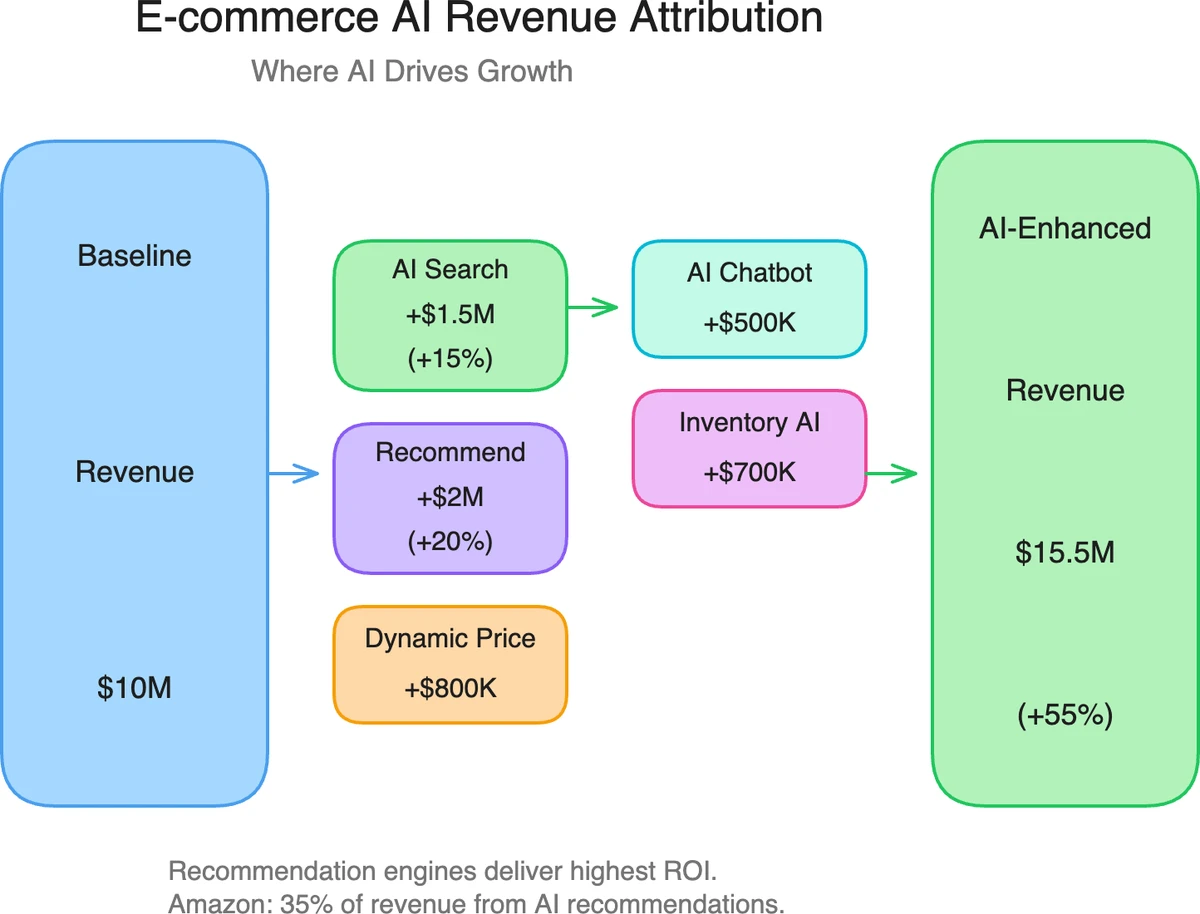
Amazon’s 35% revenue attribution is the industry benchmark, but Salesforce data shows that AI-driven recommendations influence 26% of all e-commerce revenue across its merchant network — including $229 billion in online sales during the 2024 holiday season alone.
The mechanism is straightforward: shoppers who receive relevant recommendations spend more, abandon carts less often, and return more frequently. Dynamic Yield, now owned by Mastercard, published case studies showing a luxury athletic retailer achieved a 62% increase in average order value from personalized quiz experiences, while an Italian fashion retailer increased average revenue per user by 15%. Nosto, which serves over 3,000 e-commerce brands, prices on a performance basis — you pay only for revenue generated through recommendations, not for the platform itself. Their average contract value runs approximately $47,000 annually, reflecting the revenue scale at which the tool becomes relevant.
Zalando’s implementation is instructive for fashion brands specifically. The company’s AI recommendation layer grew average basket size from €56.8 in 2021 to €61.1 by Q1 2025 — steady compounding from systematic personalization, not a one-time lift. Their generative AI tools for campaign visuals cut campaign lead times from six weeks to under one, demonstrating that recommendation engines are just one layer of a broader AI stack.
Which Tool Fits Which Store Size
| Store Size | Annual Revenue | Recommended Tool | Monthly Cost |
|---|---|---|---|
| Startup | Under $1M | Shopify Magic (built-in) | Free |
| Growth | $1M–$10M | Nosto or Klaviyo | $500–$3,000 |
| Mid-market | $10M–$100M | Dynamic Yield | $5,000–$15,000 |
| Enterprise | $100M+ | Custom or Dynamic Yield Enterprise | $15,000+ |
Email and SMS Automation: Klaviyo’s Documented Results
Email marketing remains the highest-ROI channel in e-commerce, and AI has widened the gap between brands using behavioral automation and those sending batch campaigns. Klaviyo’s benchmark data shows campaign order rates are more than 5x higher for top-performing campaigns, with repeat purchase rates running 7x the average across both email and SMS.
Klaviyo serves over 167,000 businesses and launched its AI Marketing Agent in 2025, which autonomously plans, drafts, and schedules campaigns while maintaining brand voice. Saranoni reported a 35x ROI on Klaviyo; Every Man Jack attributed 12.4% of total revenue to Klaviyo’s predictive analytics segments. One merchant generated $288,124 in attributed email revenue within 90 days of switching to the platform.
Pricing is tiered by active profile count: the free plan covers up to 250 profiles, the email plan starts at $20/month for 251–500 contacts, and scales to $400/month at 25,000 contacts. A February 2025 pricing change moved billing to “active profiles” (all contacts capable of receiving messages), causing some merchants to see 25%+ cost increases. Stores with large suppressed lists should audit profile counts before migrating.
For stores earlier in their lifecycle, Tidio’s Lyro chatbot handles up to 70% of customer inquiries automatically and integrates with email flows — small businesses report 35% increases in lead conversion. The combination of Klaviyo for email automation and Tidio for real-time chat covers the two highest-volume customer touchpoints for under $200/month at most early-stage stores.
AI Customer Support: Gorgias and the Ticket Automation Case
Customer support is where AI saves the most labor hours at measurable cost. Gorgias launched AI Agent 2.0 in July 2025 specifically for e-commerce, with deep Shopify integration that enables the agent to take actions — updating orders, processing returns, applying discounts — without human intervention. The system automates up to 60% of support tickets.
Jaxxon, a luxury jewelry brand, reduced live chat volume by 17% and lifted on-site conversion by 6% using Gorgias automation. The conversion lift is notable: better support during the purchase decision reduces abandonment, not just post-purchase frustration. Gorgias pricing runs from $10/month (Starter) to $900/month (Advanced), with AI-resolved conversations billed at $0.90 per resolution on top of the helpdesk fee. At 1,000 AI-resolved tickets per month, the AI layer adds $900 — still far below the cost of the equivalent human agent hours.
The right benchmark for evaluating AI customer support is not the software cost versus a single agent’s salary. It is the software cost versus the marginal cost of handling support volume spikes during BFCM, product launches, or shipping delays, when ticket volume can increase 3–5x in 48 hours and human teams cannot scale at that pace.
Inventory and Demand Forecasting: Where AI Prevents Silent Revenue Loss
Stockouts and overstock are silent revenue killers that rarely appear on marketing dashboards. Zara reduced excess inventory by 40% using AI forecasting. Levi’s reported a 15% reduction in stockouts and a 10% increase in inventory turnover. Whole Foods cut inventory costs by 25% after deploying AI-powered demand forecasting. These numbers represent working capital freed, not just cost savings — Zara’s 40% excess inventory reduction translates directly to cash that was previously tied up in unsold goods.
The AI inventory market grew from $7.4 billion in 2024 to $9.6 billion in 2025 and is projected to reach $27 billion by 2030. For e-commerce businesses, the most accessible entry point is Shopify’s built-in demand forecasting (available on Advanced and Plus plans), which uses historical sales data and seasonal patterns to generate reorder recommendations. Enterprise-scale operations typically deploy dedicated platforms: Toolio for fashion, Relex Solutions for grocery and retail, or custom ML models for businesses with complex SKU structures and multi-warehouse logistics.
The ROI math on demand forecasting is unusually clean: a documented 5,000-SKU/3-warehouse deployment achieved a 47% improvement in inventory turns, a 75% reduction in stockouts, $1.5 million in freed capital, and a 480% first-year ROI on a $150,000 implementation. The payback period was under 90 days.
Content Generation: Shopify Magic and What It Actually Does
Content generation is where AI creates the most immediate time savings for small e-commerce teams, even if the revenue impact is harder to isolate. Shopify Magic, included free with all Shopify plans, generates product descriptions, email subject lines, FAQ content, and background-removed product photography directly within the admin. Doe Beauty reported saving $30,000 per week and four hours of human labor through Shopify Flow automations — a figure that reflects workflow automation broadly, not content generation alone.
For teams producing higher volumes of marketing content, Jasper starts at $49/month per user and focuses on maintaining brand voice across campaigns. Marketing teams report creating 3x more content at the same headcount. The practical ceiling on content AI ROI is catalog size: a store with 500 products that takes six hours to write descriptions has a clear use case. A store with 50 products that updates descriptions quarterly does not.
ASOS offers the clearest case study on AI content and visual search combined. The company trained an AI model on 100,000 curated outfits to power its “Styled for You” feature, which generates personalized outfit suggestions. Paired with Microsoft Azure AI Studio for product copy and imagery, ASOS reduced the time from trend identification to published product page from days to hours during peak fashion weeks. The infrastructure investment required for this kind of integration is enterprise-scale, but the direction — faster content creation tied to behavioral personalization — applies at every store size.
Visual Search: The Underused Channel
Visual search remains the most underused AI capability in e-commerce relative to its documented conversion impact. Google Lens processes nearly 20 billion visual searches per month as of 2025. Pinterest Lens handled 2.5 billion visual queries monthly in the first half of 2025. Retail and lifestyle brands optimizing for visual search report 25–40% higher conversion rates from visual search traffic, because visitors who arrive via visual search already know what they want — they are showing the algorithm the item, not guessing at keywords.
Sephora’s AR-powered Virtual Artist (built with ModiFace) produced a 25% increase in add-to-basket rates and a 35% conversion lift. The AR layer reduced the purchase uncertainty inherent in buying cosmetics online without being able to test colors in person. IKEA’s visual search and AR placement tool reported similar dynamics: customers who used the AR feature were significantly more likely to complete a purchase.
Adding visual search to an existing Shopify store requires integrating a tool like Visenze or Syte — both offer Shopify apps that index your catalog and enable visual search functionality. Entry-level plans start at approximately $299/month. For fashion, home goods, and beauty brands where product appearance drives purchase decisions, visual search is one of the few AI features that pays for itself within a single product category.
What AI Cannot Do for E-commerce
AI tools do not fix a broken product-market fit, a poor returns policy, or a checkout flow with structural friction. ASOS illustrates this clearly: despite significant AI investment in personalization and recommendations, the company experienced higher churn and declining orders per customer between 2023 and 2025, attributed to return policy tightening and promotional fatigue. The AI worked — the business model variables undermined it.
The second failure mode is deploying too many tools without integration. Recommendation engine data that does not flow into email segmentation, support tickets that do not feed back into product improvement, and inventory forecasts that exist in a separate system from purchasing decisions — these are the patterns that produce AI spending without AI results. The most effective e-commerce AI stacks are those where data flows between tools: Klaviyo reads behavioral signals from the recommendation engine, Gorgias pulls order data from Shopify, and demand forecasting feeds directly into buying decisions.
Third: AI pricing in e-commerce tools is changing fast. Klaviyo raised prices three times in four years. Gorgias added per-resolution AI fees on top of existing subscription costs. Dynamic Yield’s enterprise contracts require custom negotiation. Build AI tool budgets with 20–30% pricing headroom for the 12-month period following any major platform commitment.
Frequently Asked Questions
Which AI tool produces the fastest ROI for a new e-commerce store?
Shopify Magic is the fastest path to AI value for stores on Shopify — it is free, requires no setup, and immediately reduces the time needed to write product descriptions and generate product photos with clean backgrounds. For stores past $50,000 in monthly revenue, Klaviyo’s email automation typically produces measurable ROI within 60–90 days: behavioral flows like abandoned cart sequences and post-purchase automations generate revenue from traffic you have already paid to acquire.
How much does a complete AI e-commerce stack cost per month?
A functional AI stack for a mid-stage store ($1M–$5M annual revenue) costs approximately $500–$1,500/month: Klaviyo email automation ($100–$400), Tidio or Gorgias for customer support ($50–$300), Nosto or a similar recommendation engine ($300–$800), and Shopify Magic for content (free). Enterprise stacks with Dynamic Yield, custom demand forecasting, and dedicated support AI can run $15,000–$50,000/month, justified by revenue scale.
Does AI personalization work for small catalogs?
Recommendation engines require sufficient catalog depth and traffic volume to function effectively — a store with fewer than 100 SKUs and under 10,000 monthly visitors will not see meaningful lift from a dedicated personalization platform. Klaviyo’s behavioral segmentation works at smaller scale because it acts on individual customer history rather than cross-catalog similarity. Focus email automation first; add recommendation engines when catalog size and traffic volume create enough data for the algorithms to learn from.
How does Stitch Fix use AI differently from standard recommendation engines?
Stitch Fix combines algorithmic recommendations with human stylists in a hybrid model: AI selects a candidate set of items based on the customer’s style profile and past keeps/returns, and a human stylist makes the final selection from that shortlist. By 2024, AI-driven selections accounted for 75% of what was shipped. The model reduced return rates by 30% and increased average order value by 40%. The key insight is that the AI handles breadth (processing millions of product-profile combinations) while humans handle judgment calls on edge cases and novel style combinations.
What is the difference between Dynamic Yield and Nosto?
Both are personalization platforms for e-commerce, but they serve different scale points. Nosto targets brands in the $1M–$50M revenue range with performance-based pricing (you pay as a percentage of influenced revenue) and faster implementation via pre-built Shopify and Magento integrations. Dynamic Yield, acquired by Mastercard in 2022, targets enterprise retailers and QSR chains with more sophisticated experimentation capabilities, multi-channel personalization across web, mobile, email, and in-store systems, and higher minimum contract values. For most independent e-commerce brands, Nosto is the appropriate starting point; Dynamic Yield becomes relevant at enterprise scale or when multi-channel personalization is a strategic priority.
When does AI customer support pay for itself?
Gorgias AI support pays for itself when the cost of AI-resolved conversations is lower than the labor cost of human-resolved equivalents. At Gorgias’s $0.90 per AI-resolved ticket, a store handling 2,000 support tickets per month with a 60% automation rate (1,200 AI-resolved tickets) spends $1,080/month on AI resolutions. If a full-time support agent costs $3,500/month and handles 1,200 tickets, the AI layer is 69% cheaper. The ROI accelerates during traffic spikes when human teams cannot scale without overtime or temporary hires.
Key Takeaways
- Amazon’s recommendation engine generates 35% of total revenue ($70 billion annually) — the benchmark for what mature AI personalization produces at scale
- Stitch Fix increased AOV by 40% and reduced return rates by 30% using a human-AI hybrid recommendation model; Zalando’s AI assistant reduced return rates by 7% in pilot testing
- Klaviyo’s AI-powered 2025 BFCM generated $3.8 billion in attributed revenue across its merchant base, with top campaigns achieving 5x the order rate of average campaigns
- Gorgias AI Agent 2.0 automates 60% of e-commerce support tickets at $0.90 per AI-resolved conversation — ROI is positive when compared to marginal human support costs during volume spikes
- Zara cut excess inventory 40%, Levi’s reduced stockouts 15%, and a documented 5,000-SKU deployment achieved 480% first-year ROI on AI demand forecasting — working capital impact, not just cost savings
- Visual search converts at 25–40% higher rates than text search for fashion, beauty, and home goods; Google Lens processes 20 billion visual queries per month as of 2025
- AI tools do not fix broken business fundamentals — ASOS’s personalization investments were undermined by return policy tightening; integrate data across tools before adding more tools
- Build AI tool budgets with 20–30% pricing headroom: Klaviyo raised prices three times in four years, and per-resolution AI fees are becoming standard across support platforms
SFAI Labs